

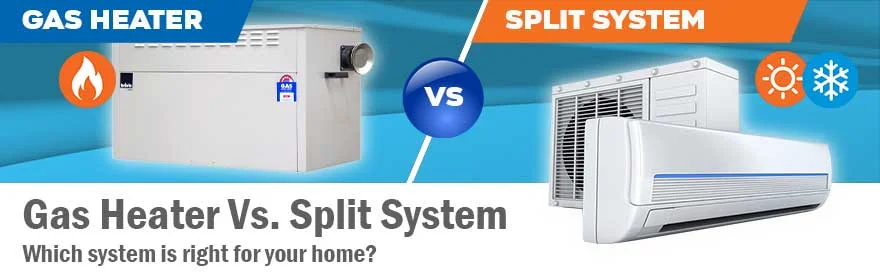
Gas prices keep climbing, old ducted heaters keep breaking down, and every second tradesperson seems to be quoting you a split system as the answer. But is it actually the right move for your home?
Replacing ducted gas heating is a big decision. Done right, it can cut your energy bills, improve comfort zone by zone, and future-proof your home as gas costs continue to rise. Done poorly, you end up with a patchwork of mismatched units, walls full of abandoned vents, and a rebate quote that looked cheap until the hidden extras showed up.
This guide covers everything you need to know before you commit. From honest cost comparisons to what actually happens to your old gas vents, we’ve laid it out in plain language so you can make the right call for your home.
1. Split Systems vs Ducted Gas Heating: Which Is Better for Older Homes?
Older homes in Sydney were built for gas. The ducted heating system runs through the ceiling or under the floor, and it’s been doing its job for 20-plus years. So why switch?
Mainly because gas prices have roughly doubled in a decade, and that old heater is almost certainly far less efficient than what’s available today.
Split system air conditioners run on electricity and use a heat pump process, meaning they move heat rather than generate it. Modern units can deliver 3-4 units of heat for every 1 unit of electricity consumed. No gas heater can match that ratio.
| Factor | Ducted Gas Heating | Split System (Reverse Cycle) |
| Heating efficiency | 70-90% of gas converted to heat | 300-400% efficiency (heat pump) |
| Cooling | Heating only — no cooling capability | Both heating and cooling in one unit |
| Older home suitability | Already installed — minimal disruption to maintain | New install required — small wall penetrations per unit |
| Zone control | Whole-house or basic zone shutters | Individual room control — heat only what you use |
| Running cost (approx.) | $1.20–$1.80/hr at current gas rates (large home) | $0.30–$0.60/hr per unit on typical tariffs |
| Upfront cost | Replacement $3,000–$8,000+ | $1,500–$3,000 per unit installed (varies by size) |
| Future proofing | Gas costs likely to keep rising; some states phasing out gas connections | Compatible with solar, battery storage, and green tariffs |
Older homes key consideration: If your home has solid brick walls or limited roof space, a split system is often the easier installation compared to a full ducted system replacement. One outdoor unit per group of rooms, minimal structural work, and no requirement to disturb existing ceiling cavities.
2. Multi-Head Split System vs Individual Split Systems: Which Is Better?
Once you’ve decided to go with split systems, the next question is whether to run individual units in each room or connect multiple indoor heads to a single outdoor unit. Both approaches work — but they suit different homes and budgets.
A multi-head split system connects 2-5 indoor units to one outdoor compressor. Individual split systems give each room its own dedicated outdoor unit. Here’s how they compare:
| Factor | Multi-Head Split System | Individual Split Systems |
| Outdoor unit space | One outdoor unit for multiple rooms — cleaner look | One outdoor unit per indoor unit — takes more space |
| Upfront cost | Lower overall — fewer outdoor units and less installation labour | Higher — each room requires a separate full system |
| Independent operation | Limited — some multi-head systems struggle when only 1 of 4 rooms is running | Full independence — run one room without affecting others |
| Efficiency at low load | Can be less efficient when only 1-2 heads are running off a large compressor | Each unit runs at its optimal load regardless of other rooms |
| Fault impact | If the outdoor unit fails, all rooms lose heating and cooling | A fault only takes out the affected room — others keep running |
| Best suited for | Apartments, townhouses, smaller homes where rooms are used together | Larger homes where different family members use rooms independently |
| Servicing cost | One outdoor unit to service — lower long-term maintenance cost | Multiple outdoor units — higher long-term servicing cost |
Our recommendation: For a 3-4 bedroom home replacing ducted gas, a combination often works best. Install a multi-head system for the living areas (where rooms are used simultaneously) and individual units for bedrooms (where independent operation matters). Ask your installer to model both options with running cost estimates before deciding.
3. Ducted Reverse Cycle vs Split Systems: Which Is Best on a Budget?
When you’re replacing gas heating, you essentially have two paths: swap to a ducted reverse cycle system (which uses your existing ductwork) or install split systems room by room. Both cost money upfront. The right choice depends on your home’s layout, your existing ductwork condition, and what budget you’re working with.
| Cost Factor | Ducted Reverse Cycle | Split Systems (Multiple) |
| Upfront install cost | $6,000–$15,000+ (whole home) | $1,500–$3,000 per unit — can stage the investment room by room |
| Ductwork condition risk | Old ducts may need replacement — adds $2,000–$5,000 to the job | No ducting required — avoids this risk entirely |
| Running costs | Heats entire home — higher running cost if you only need 2-3 rooms | Heat only the rooms you’re actually using — lower running costs for smaller households |
| Staging the spend | All-or-nothing cost — full system must be installed at once | Install the living room unit now, add bedrooms next year — spreads the cost |
| Aesthetics | Completely hidden — vents in ceilings, no wall units visible | Wall-mounted indoor units visible in each room |
| Best for | Large open-plan homes used heavily across all rooms, existing ductwork in good condition | Budget-conscious homeowners, older homes where ductwork may be compromised, or homes where only select rooms need heating |
The honest answer: if your existing ductwork is less than 10 years old and in good condition, ducted reverse cycle is worth considering seriously. If your ducts are older, leaking, or you only need 2-4 rooms covered, split systems almost always deliver better value per dollar spent. Always get a ductwork condition assessment before committing to a ducted reverse cycle quote — duct replacement costs can blow out a budget quickly.
4. What Happens to Old Gas Heating Vents After You Install Split Systems?
This is the question most homeowners don’t think to ask until after the split systems are installed. You’ve got warm rooms, lower bills — but now there are rectangular holes in your ceiling (or floor vents) that used to be connected to your ducted gas heater. What do you do with them?
The answer depends on whether you’re keeping any part of the gas system, what condition the ducts are in, and how much finish work you want to invest in.
| Vent Situation | What Typically Happens | Cost to Address |
| Ceiling vents (heating only) | Duct is disconnected and capped. Vent cover is removed and hole is patched and painted. | $80–$200 per vent (plastering and paint) |
| Floor vents (under-floor heating) | Duct capped under floor. Vent cover removed and floor section patched to match. | $100–$300 per vent (depends on floor material) |
| Leave vents in place (cosmetic fix) | Cover plate left in place over capped duct — cost is nil but duct can collect dust and insects. | $0 upfront, but not recommended long-term |
| Full duct removal | All ductwork removed from ceiling or subfloor cavity. Cleanest result but most disruptive. | $1,500–$4,000+ depending on system size |
| Gas heater unit removal | Gas appliance must be decommissioned by a licensed gasfitter. Gas line must be capped at the meter or point of supply by a licensed professional. | $200–$600 for decommissioning (varies by complexity) |
Important: Gas appliance decommissioning and gas line capping must be carried out by a licensed gasfitter — not the air conditioning installer. Make sure your quote includes clarity on who handles this work and whether it is priced in. In NSW, capping a gas line requires a licensed plumber with a gasfitting licence. Do not leave a gas line uncapped.
5. Are Split System Rebates Worth It? What to Check Before You Say Yes
Split system rebates sound great on paper. The NSW and Federal governments have programs that can reduce the cost of upgrading to an energy-efficient reverse cycle system. In some cases, rebates and incentives can shave $600–$1,500 off the installed cost. But there are conditions, and not every rebate is as straightforward as the flyer makes it look.
| What to Check | Why It Matters | Red Flag to Watch For |
| Which rebate scheme applies | NSW PDRS (Peak Demand Reduction Scheme) and Federal STCs (Small-scale Technology Certificates) are the main ones. They are not the same and have different eligibility rules. | Quotes that vaguely mention “government rebates” without specifying which scheme |
| Eligibility requirements | Many rebates require you to be replacing gas or electric resistance heating, not just adding an extra unit. Eligibility can depend on your home’s current heating type. | Being told you qualify without the installer actually confirming your current setup |
| Brand and model restrictions | STC rebates are based on the energy efficiency rating of the specific unit installed. A cheaper, lower-rated unit may generate fewer STCs and reduce your actual saving. | Installer pushing a specific brand and citing rebates as the reason — they may be maximising their own STC income |
| Who actually receives the rebate | In most STC arrangements, the installer assigns the certificates on your behalf and discounts the invoice accordingly. You should see the rebate value itemised in the quote. | A quote that mentions rebates but shows no line-item discount |
| Timing and availability | Some rebate programs have limited funding and close once the cap is reached. Don’t make a decision based on a rebate that may not still be available by your install date. | High-pressure language about the rebate “closing soon” — always verify independently |
| Concession eligibility | Some state-based rebates offer higher values for pensioners and concession card holders. Always check if additional concessions apply before accepting a standard quote. | Not being asked about your concession status at point of quote |
The bottom line on rebates: they are real and they do reduce your cost. But treat them as a bonus on a good decision, not the reason to rush a decision. A well-specified split system at full price will still pay for itself far faster than a cheap unit chosen purely to qualify for a rebate program. Our team at Air-Max Air Conditioning installations can confirm which rebates currently apply to your specific situation before you commit.
6. Why Cheap Rebate Split System Quotes Need a Closer Look
The rise of government rebate schemes has also given rise to a particular type of quote that looks outstanding until you read the fine print. We see it regularly — homeowners call us after accepting a rebate quote, only to find out the system installed is undersized, the brand is obscure, the warranty is minimal, or there are “extras” that weren’t mentioned upfront.
Here’s what to look for when reviewing any quote that leads with a rebate or discount:
| What to Look For in the Quote | Why It Matters | Green Flag vs Red Flag |
| Brand and model name specified | You need to know exactly which unit is being installed so you can research its energy rating, noise level, and reliability independently. | Green: Specific brand/model listed. Red: “Energy-efficient split system (subject to stock)” or similar vague wording. |
| Capacity (kW) stated | Undersizing is common in cheap rebate jobs. A 2.5kW unit in a 40sqm living room is not enough. Capacity should be calculated based on room size, insulation, and orientation. | Green: kW stated per room. Red: No capacity listed, or the same size is offered for every room. |
| Installation inclusions | Cheap base quotes often exclude: additional pipe runs, electrical upgrades, wall penetration repairs, and condensate drain work. These can add $200–$600 per unit. | Green: Inclusions listed clearly. Red: “Standard installation only, additional costs may apply.” |
| Warranty terms | Cheaper or less-known brands may offer only 1-2 year warranties. Reputable brands like Daikin, Fujitsu, and Mitsubishi offer 5-year manufacturer warranties as standard when installed by licensed contractors. | Green: 5-year warranty on parts, compressor, and workmanship. Red: Warranty terms not stated. |
| Installer licence and compliance | In NSW, all air conditioning installations must be carried out by a licensed refrigerant handling technician. Some rebate scheme operators use unqualified subcontractors to cut costs. | Green: ARCtick licence number on quote. Red: No licence details or third-party subcontractor mentioned with no credentials. |
| STC value passed to you | The rebate from STCs belongs to you. The installer assigns them on your behalf and should discount your invoice accordingly. Verify the STC discount is actually reflected in the final price. | Green: STC value itemised on quote. Red: Rebate mentioned, but price is not broken down. |
Our honest take: The cheapest rebate quote is almost never the best outcome. A correctly sized, properly installed system from a reputable brand will run for 10-15 years with minimal servicing. A cut-price job may save you $400 upfront but cost you three times that in repairs, higher running costs, and premature replacement. Get at least two quotes. If one is significantly cheaper than the other, ask exactly where the saving is coming from.
Ready to Make the Switch?
Get an honest, itemised quote from Air-Max. We’ll assess your current heating setup, confirm which rebates apply, and recommend the right system for your home, no vague pricing, no hidden extras.
Frequently Asked Questions
Is it worth replacing ducted gas heating with split systems?
In most cases, yes. Modern reverse cycle split systems are 3-4 times more efficient than gas heating on a cost-per-unit-of-heat basis, and they also provide cooling in summer. The payback period depends on your current gas usage, but most households recover the installation cost within 3-5 years through lower bills.
Can I keep my gas ducting and just replace the heater unit with a reverse-cycle system?
In some cases, yes. If your ducting is in good condition and the layout is compatible, a ducted reverse cycle system can connect to existing ductwork. However, older ducting is often leaky, undersized for reverse cycle airflow, or made from materials that degrade over time. A condition assessment is essential before committing to this path.
Do I need a licensed gasfitter to remove my old gas heater?
Yes. In NSW, decommissioning a gas appliance and capping the gas supply line must be carried out by a licensed plumber with a gasfitting licence. This is separate from the air conditioning installation work. Ensure your quote clarifies who handles this and that it is compliant.
How many split system units do I need to replace the ducted gas heating?
It depends on your home’s layout and which rooms you actually use. Most 3-4-bedroom homes use 2-4 split-system units effectively: one large unit for the main living area and individual units for regularly occupied bedrooms. You don’t need to replicate every gas vent with a split system.
Which split-system brands are most reliable?
Daikin, Mitsubishi Electric, and Fujitsu are consistently rated as the most reliable brands in Australia, with strong warranty support, widely available parts, and established service networks. Air-Max installs all three and can advise on the best option for your room sizes and budget.
